Most product weeks are about adding things users can see. This one was about replacing the plumbing underneath what they already use, so the things they care about feel faster, more consistent, and easier to extend.
A foundation week: faster streaming, a new front door, and a real staging environment
Most product weeks are about adding things users can see. This one was about replacing the plumbing underneath what they already use, so the things they care about, like CTCAE grading and adverse event review, feel faster, more consistent, and easier to extend.
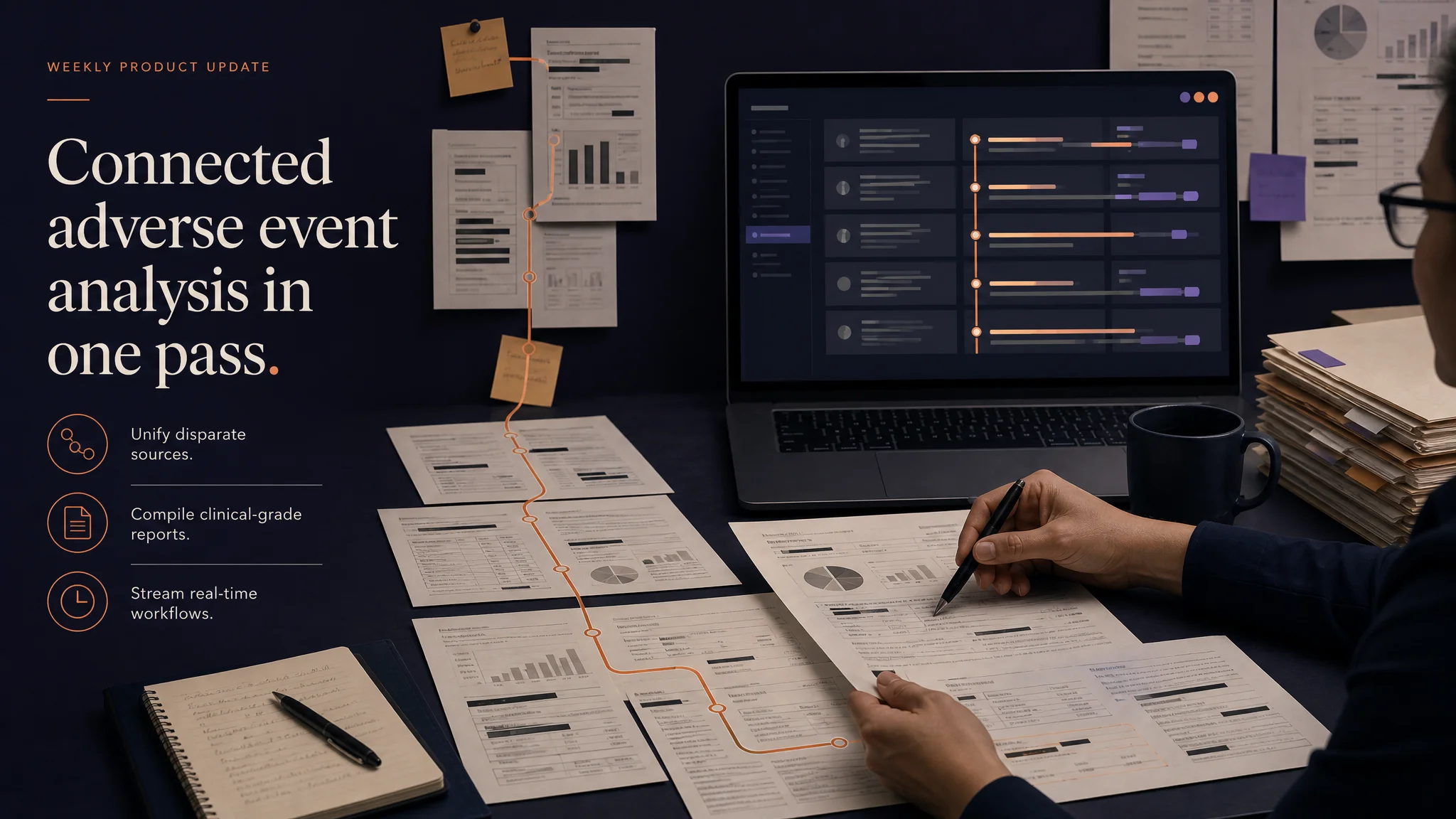
This week we migrated the real-time streaming pipeline behind every AI workflow onto a native workflow protocol. We also launched the new public marketing site at burna.ai and stood up a true staging environment for QA validation before changes hit production.
Here is what shipped, why it matters, and what is next.
Feature Highlight 1: Workflow streaming on a native protocol
For several months, the CTCAE grading, drug attribution, and drug interaction analysis workflows streamed step-by-step progress to the provider app via a generic text-stream layer. The frontend polled, parsed, and reshaped the data into a structured workflow event interface that the display components understood. It worked, but it carried three real costs:
- Tight coupling between backend storage shape and UI rendering logic
- Duplicate parsing spread across three display components (web, web v2, mobile)
- Latency added by the polling roundtrip
This week we replaced that pipeline with a native workflow protocol and a clean transport hook. The transport automatically maps native step status (running, completed, failed) to the existing event interface, so the display components did not change at all. We also extracted the duplicated step-name constants into a single shared utility, removing about a hundred lines of duplicate logic across the three components.
A few practical effects:
- Auth headers and organization context now propagate explicitly per request, which makes multi-tenant correctness easier to reason about
- We can now treat clinical workflows as first-class streaming entities the same way the broader AI ecosystem treats chat, which sets up future composition (multi-step workflows, parallel runs)
- The default and medical model used for clinical reasoning bumped to a stronger reasoner in the same change
Why it matters: live AI workflow progress feels faster and more deterministic, the codebase has a hundred-plus fewer lines to maintain, and we now have a clean substrate to build multi-workflow compositions on. Same UX, better foundation.
Feature Highlight 2: The new burna.ai website
burna.ai is now live with dedicated content for every audience that needs to understand what we do. The new site spans:
- Audience pages: home, healthcare providers, life sciences, clinical research, patients
- Company pages: about, careers, press, contact, request demo
- Trust pages: trust center, security and compliance, technology
- Investor portal: a gated route with progress, stats, tabbed product demo, team, and testimonials
- Pitch deck: standalone slides for partner conversations
Behind the scenes, the same release landed outreach automation infrastructure and the social video stack. Preview deployments keep the marketing site decoupled from the product apps.
Why it matters: until now, prospects, partners, and investors landed on a placeholder. The new site is the canonical front door for explaining what Burna AI does, who it serves, how it stays compliant, and how to engage. The investor portal gives us a controlled surface to share progress with active conversations without publishing it openly.
Feature Highlight 3: Staging environment and cleaner origin configuration
Until this week, our trusted-origins (the CORS allow-list) lived in a shared package and were imported by every service that needed them. Updating staging or production origins meant touching shared code, which meant a wider PR surface and more risk of unrelated regressions.
We moved that configuration into the API layer and made it the single source of truth for origin validation. We added two new origins, staging-app.burna.ai and staging-care.burna.ai, so the provider and patient apps can run in a true pre-production environment with the same auth and CORS posture as production.
We also gated the in-progress Grading navigation items in the provider app to development-only mode, so users do not see partially-built features in production.
Why it matters: we can now validate releases in a staging environment that behaves like production, instead of merging straight to prod and hoping. Lower risk, faster iteration, fewer surprise hotfixes.
Other improvements and bug fixes
Performance and bundle size
- Settings modal code splitting: the eleven tabs in the provider settings modal now load lazily. Initial bundle is about 45 KB lighter and time-to-interactive improved by approximately 400 ms.
- Dependency modernization: updated a hundred-plus dependencies. Migrated canvas rendering to a faster native binary for approximately a twelve percent bundle reduction.
Reliability and polish
- Workflow stream step IDs are now correctly read from the top-level event object so step IDs propagate into the run-ID field. Authentication mutation hardened with explicit typing and a defensive null check.
- CORS posture strengthened. User profile parsing made safer with proper first-name and last-name handling. Chat-widget initialization made resilient.
- Consolidated HTTP clients onto native fetch and removed the unused integration package. Extracted storage initialization into a dedicated module for cleaner separation.
- Provider app issues sweep, provider web filtering refactor to eliminate stale-state issues, and patient mobile iPad UI and token login edge cases resolved.
- Knowledge base permissions now recognize organization admin status independently of member role.
Infrastructure
- Hotfix removing orphaned and duplicate dependency entries across the monorepo.
Looking Ahead
With workflow streaming on a clean native foundation, the next questions get more interesting. Can we run multiple workflows in parallel against the same encounter without re-architecting the streaming layer? Can we let coordinators replay a step from any point in the run? Can we surface intermediate AI reasoning to the clinician in a way that is genuinely useful instead of overwhelming?
We are also continuing to harden the new website, the staging pipeline, and the PRO token reissuance flow that landed the past two weeks.
AI suggests, clinicians decide. Human-in-the-loop, always.