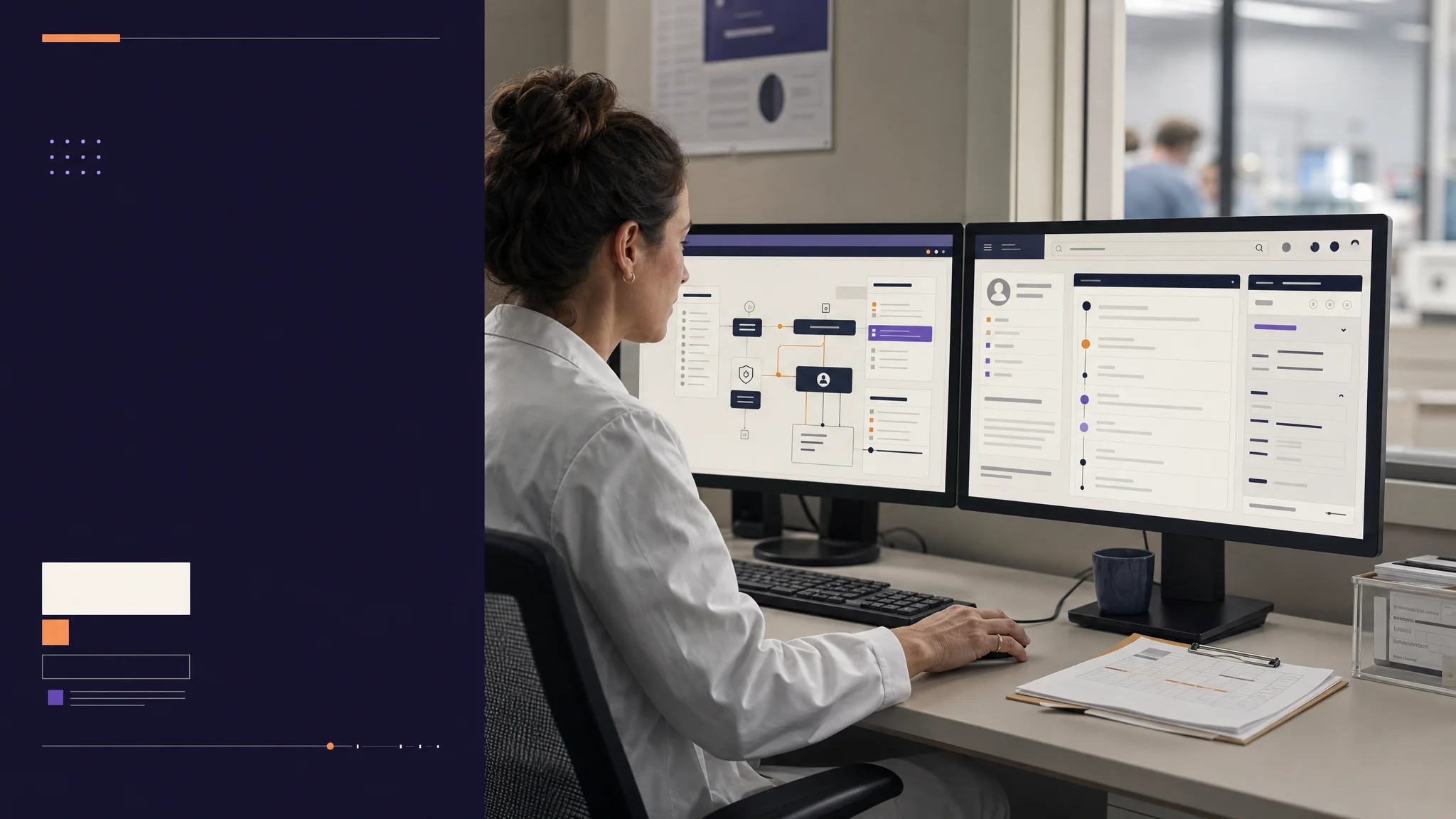
Clinical trial sites need their tools to work together. This week we closed the loop with the electronic health record. Coordinators authenticate with their existing clinical credentials, and patient demographics, encounters, observations, and conditions flow directly into the grading workflow.
Closing the loop with the electronic health record
Clinical trial sites running oncology protocols need their tools to interoperate. When coordinators copy patient data between systems, toggle between browser tabs, or re-enter adverse event details manually, errors creep in and time disappears. The conventional clinical software response to this problem is "we sync with the EHR overnight." That answer is structurally insufficient for clinical trials, where the grade a coordinator records at 10:14 needs to reflect the encounter as it exists in the EHR at 10:14, not as it existed at 23:00 the night before.
This week we closed the loop. Coordinators authenticate directly with their existing clinical credentials in Epic, Oracle Health, or AthenaHealth. Patient demographics, encounters, observations, conditions, and medication requests flow into the grading workflow on demand. We also hardened the multi-rater quality program with submission-gated blinding and brought Medical Record Number search into the patient lookup.
Here is what shipped, why it matters, and what is next.
Feature Highlight 1: End-to-end EHR integration
The platform now supports full clinician-level OAuth authentication with Epic, Oracle Health (formerly Cerner), and AthenaHealth through the SMART on FHIR standard. This is the same integration pattern these EHRs already support for other clinical applications. No custom development, no IT project, no months of engineering effort on the site's side.
When a coordinator authenticates, the platform securely accesses patient data under clinician-level scopes. Patient demographics, encounters, observations, conditions, and medication requests are available to the grading workflow. The OAuth callback chain is hardened with secure cookie handling, audience parameter validation, and stable user identity from ID tokens. The integrations panel reads connection status reactively, so the coordinator always sees the real connection state, not a cached one.
The downstream effect: the coordinator stops being the integration layer between the EHR and the grading tool. The data flow is direct.
Feature Highlight 2: Submission-gated blinding
Multi-rater grading depends on rater independence. Conventional implementations leave a gap where administrators or adjudicators can view a rater's work-in-progress before formal submission. That visibility is enough to bias the subsequent assessment, even unintentionally.
The new submission-gated blinding enforces a hard boundary. Administrators and adjudicators see a rater's CTCAE grades only after the rater formally submits. Progress indicators on the case dashboard show real-time status (in-progress versus submitted) without revealing the intermediate work itself.
Under the surface, the data model was restructured to separate grading cases from grading events with a per-user identity on each event. This enables per-user progress tracking and a complete per-rater audit trail without leaking the work-in-progress.
Feature Highlight 3: MRN-based patient search
Coordinators can now search for patients using the Medical Record Number alongside name fields. A single search field handles all three identifiers through a composite search index. The index updates automatically when patient records change, so search results never lag behind the database state.
The MRN field is visible throughout the patient workflow: the patient list, the add-patient form, and the patient details drawer. A backfill ensures existing patients are searchable immediately.
The reason this matters: across a multi-site trial, coordinators often have the MRN from the source EHR but not yet the patient's name in the trial system. Searching by MRN closes that gap without a manual cross-reference step.
Improvements
Analytics
- Live operational data replaces placeholder values across all four dashboard tabs
- Feature-usage tracking for voice recording, transcription, and template workflows
Security
- Organization-scoped access enforcement prevents cross-organization data access for graders
- Standardized identity types across all grading-related tables
- New index on rater plus organization for efficient access-control queries
User experience
- Dedicated organization picker page for onboarding and team switching
- Settings modal persists after save (no more reopening for multi-field edits)
- Patient creation auto-assigns to the active visit during an encounter
- Search page uses the standard layout container
Infrastructure
- Operations automation flows for customer support and content generation, isolated from the clinical surface
Bug fixes
- Login redirect after email verification now routes to the dashboard instead of a missing page
- Logout properly redirects to the sign-in page
- Auth layout scrolls correctly on smaller viewports
- OAuth redirect URIs are normalized to prevent trailing-slash mismatches
Looking Ahead
Two pieces of work this week have particular regulatory significance. Submission-gated blinding is a structural approach to maintaining independence in multi-rater workflows, and it directly supports the FDA expectation of unbiased multi-rater assessments. The organization-scoped access enforcement closes a multi-tenant separation expectation that gets asked about in every security review.
Next: writing approved CTCAE grades back to the EHR, expanded agreement-matrix analytics from production data, and a patient-facing mobile surface for continuous adverse event monitoring between clinic visits.
Burna AI is a clinical AI platform for oncology clinical trials. CTCAE grading using WHO-UMC and Kramer attribution, citation-bound by design. Strong agreement with expert clinicians in ongoing internal testing. AI suggests, clinicians decide. More at burna.ai.